18,100 people a month search for the Illiyoon Ceramide Ato Concentrate Cream in English. That is one of the biggest single-product search numbers in Korean skincare — bigger than the brand name itself.
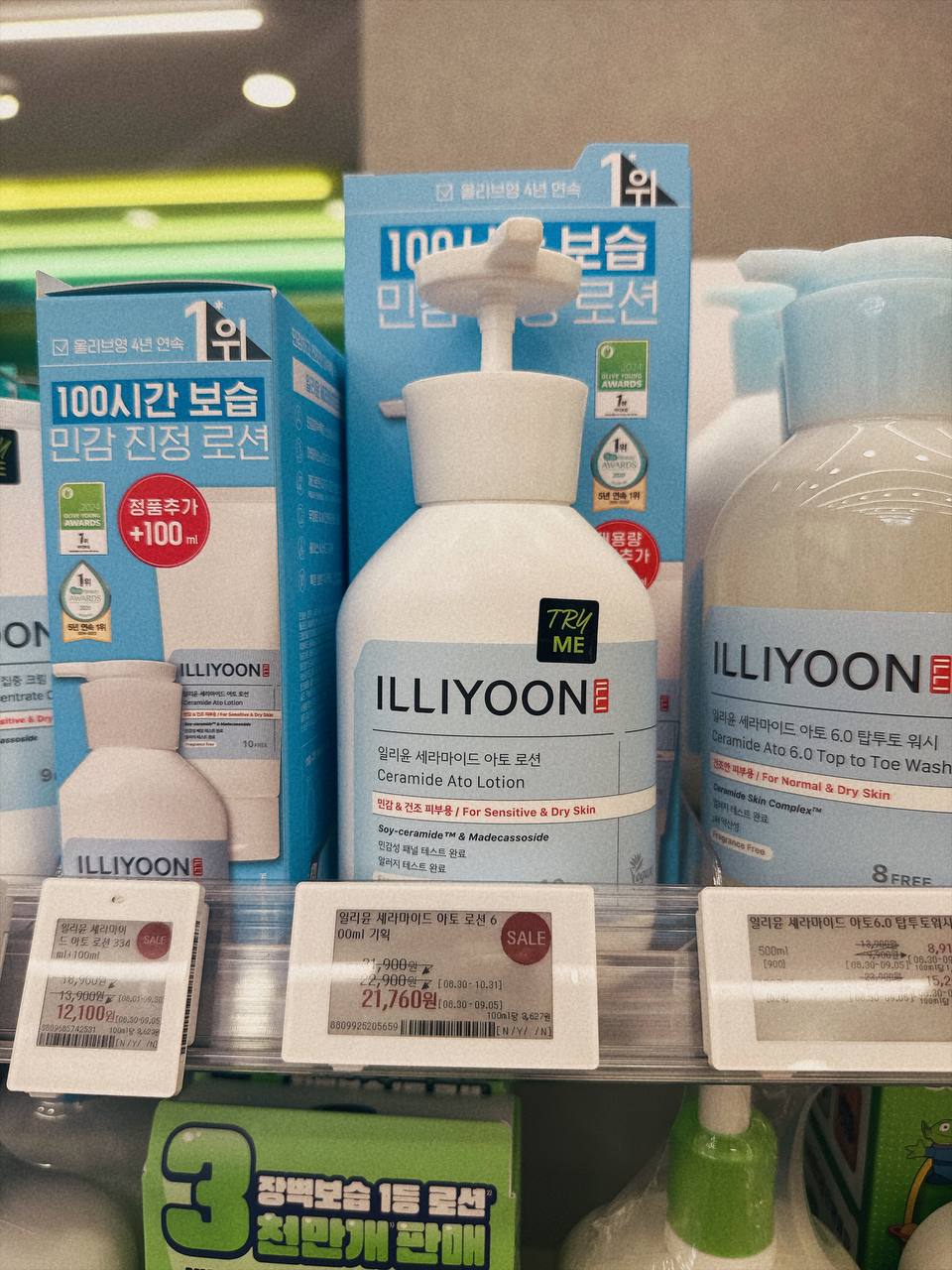
On the Olive Young shelf in Seoul, the cream is a box off to the side. The thing that gets a crowned header, a four-years-running badge and the whole middle of the bay is the lotion.
That is not a small discrepancy. It is a straight inversion, and it decides which product you should be putting in your basket.
The inversion, in numbers
| Korea | English-speaking | |
|---|---|---|
| Brand | 일리윤 — 3,600 | illiyoon — 9,900 |
| Ceramide Ato Lotion | 1,900 · 일리윤 로션 390 · 아토 로션 170 | 2,400 · illiyoon lotion 880 · illiyoon ato lotion 140 |
| Ceramide Ato Concentrate Cream | 480 · 일리윤 크림 210 · 아토 크림 50 | 18,100 |
| Ratio | lotion is 4× the cream | cream is 7.5× the lotion |
Read the last row twice. In Korea the lotion pulls four times the search of the cream. In English the cream pulls seven and a half times the search of the lotion. Same brand, same line, opposite hero.
And people notice something is off: 110 searches a month go to “illiyoon cream vs lotion” and “illiyoon ceramide ato concentrate cream vs lotion.” Nobody has answered that question from the Korean shelf, which is what the rest of this post is.
⚠️ A caveat on the numbers: Korea runs most of its searches through Naver rather than Google, so Google’s Korean figures understate domestic interest. I use them for relative comparison inside one market, never as a headcount. The inversion holds because both columns are read the same way.
What the Korean shelf actually says
The Illiyoon bay at Olive Young, photographed in September 2026. The signage is doing all the work for the lotion:
올리브영 4년 연속 1위 — Olive Young No.1, four consecutive years
100시간 보습 · 민감 진정 로션 — 100-hour moisture, sensitive-soothing lotion
OLIVE YOUNG AWARDS 1위 · 5년 연속 1위 — award first place, five years running
정품추가 +100ml — extra 100ml of the full product included
Four and five consecutive years is the part worth pausing on. Olive Young’s rankings and awards track sales inside Korea, so a product that stays first for that long is not riding a launch push — it is being repurchased by the same households.
None of that signage is attached to the Concentrate Cream. The cream’s box sits at the end of the same shelf, without a crown.
The Korean prices, and the per-ml trap
Straight off the electronic labels:
| Item | Price |
|---|---|
| 일리윤 세라마이드 아토 로션 334ml + 100ml | ₩19,900 → ₩13,900 → ₩12,100 |
| 일리윤 세라마이드 아토 로션 600ml 기획 | ₩27,900 → ₩22,900 → ₩21,760 (label’s own figure: ₩3,627 per 100ml) |
| 세라마이드 아토 6.0 탑투토 워시 500ml | on the same shelf, price label not legible in my photo |
Now do the arithmetic the shelf does not do for you. The 334ml + 100ml bundle is 434ml for ₩12,100, which is ₩2,788 per 100ml. The 600ml at ₩21,760 is ₩3,627 per 100ml.
The smaller bundle is about 23% cheaper per millilitre than the big one. The 600ml pump looks like the value size and is not, at these promotional prices. This is the single most useful thing on that shelf and it is invisible unless you divide.
[🇰🇷 Kate 확인 필요] — 집중 크림(Concentrate Cream) 자체 가격표. 사진에서 크림 박스는 잡혔지만 그 아래 라벨이 로션 라벨과 겹쳐 읽기 애매하다. 크림 실가격이 확인되면 위 표에 한 줄 추가하고 로션과 ml당 단가를 비교한다. 확인 전에는 크림이 더 비싸다/싸다고 쓰지 않았다.
[🇰🇷 Kate 확인 필요] — 매대 하단 초록 박스의 판매 수량 배지(“장벽보습 1등 로션 ○천만개 판매”). 숫자가 다른 제품 POP 와 겹쳐 확실하지 않아 본문에 넣지 않았다.
Cream or lotion: which one you actually want
They are not two sizes of one product. They are two textures for two jobs, and the Korean shelf splits them the way Korean shoppers use them.
| Ceramide Ato Lotion | Ceramide Ato Concentrate Cream | |
|---|---|---|
| Format | Pump bottle, 334ml / 600ml | Tub / tube, small |
| Texture | Thin, spreadable | Thick, occlusive |
| Built for | Body, and large areas, daily, whole family | Face, or targeted dry patches |
| Korean shelf position | Hero, crowned, four-year No.1 | Side of the same bay |
| Search interest | Korea’s choice | The English-speaking market’s choice |
| Named on the tube | 민감 & 건조 피부용 — for sensitive & dry skin | Concentrate — the same complex, denser |
Both carry the same core: Soy-ceramide™ and Madecassoside, with the packaging noting sensitivity-panel and allergy testing completed.
So the honest answer to “cream or lotion” is a question back: how much surface area are you covering? If the answer is arms, legs and torso through a dry winter, Korea is right and you want the lotion in the 434ml bundle. If the answer is a face, or the backs of your hands, or eczema-prone patches behind the knees, the cream is the denser option and the English-speaking market is right.
What is not true is that the cream is the upgrade. It is the concentrate. Those are different claims.
Where it sits against the other Korean barrier names
Illiyoon is not the only barrier product on that floor, and 170 people a month search the comparison directly.
| Illiyoon Ceramide Ato | AESTURA Atobarrier 365 | |
|---|---|---|
| Section | General skincare / body care aisle | 더마 (derma) block, its own signage |
| Size | 334ml · 600ml | 80ml tube |
| Cost per 100ml | ₩2,788–3,627 | Higher — a fraction of the volume at a similar absolute price |
| Positioning | Bulk family staple | Derma-counter, dry & sensitive |
| Both markets agree? | No — Korea buys lotion, abroad buys cream | Yes — same hero product in both |
That is the practical split. Illiyoon is what a Korean household buys by the litre. AESTURA is what someone buys when their skin is reactive and they have walked to the derma section on purpose. If you are choosing between them, you are choosing between volume and specificity, not between good and better.
How to use it
The packaging and the Korean shelf copy point the same way:
- After the shower, on skin still slightly damp. The 100-hour moisture claim on the lotion is a humectant-plus-occlusive claim; it needs water underneath it to hold.
- Lotion for area, cream for patches. Pump the lotion over limbs and torso; press the cream into the spots that crack.
- Fragrance-free and allergy-tested, which is why this line is the default for Korean households with children and for people who react to scented body lotions.
- Daily, not as a treatment. Nothing in this line is active. It is barrier support, so consistency beats quantity.
There is also a Ceramide Ato Soothing Gel in the same line, which pulls 1,000 English searches a month on its own — a lighter summer option than either the cream or the lotion.
[🇰🇷 Kate 확인 필요] — 전성분표 뒷면 사진. “concentrate cream ingredients” 가 영어권에서 월 590건이고 상위 글 대부분이 전성분을 싣는다. 뒷면 사진이 있으면 이 섹션이 근거로 완성된다.
Is it good for eczema?
This comes up constantly, and it deserves a careful answer rather than an enthusiastic one.
The line is built for and labelled for dry and sensitive skin, with soy-ceramide and madecassoside, fragrance-free, and with sensitivity and allergy panel testing noted on the packaging. In Korea it is the mass-market default for exactly that kind of skin — that is what four consecutive years at No.1 in a general drugstore means.
What it is not: a treatment. Eczema is a medical condition, and a barrier moisturiser supports the skin between flares rather than resolving them. Use it as the emollient layer alongside whatever your doctor has prescribed, not instead of it.
If your skin is reactive as well as dry and you want something from a dermatological line rather than the general aisle, that is the AESTURA comparison above.
Who this is for
Buy the lotion if: you are covering body-sized areas, you want the product Korea actually repurchases, and you want the best cost per millilitre on the shelf — the 334ml + 100ml bundle, not the 600ml.
Buy the cream if: your target is your face or specific cracked patches, and you want the denser concentrate of the same complex.
Skip the line if: you want actives. There are none here, deliberately. For that end of the Korean shelf see what Koreans actually buy at Olive Young.
Note if: you are shopping from a review that only named “the cream.” Check whether the reviewer was covering a face or a body. Most of the English-language coverage of this brand is face-first, which is how an 18,100-search cream ended up outranking Korea’s actual No.1.
[🇰🇷 Kate 확인 필요] — 실사용 후기. 써봤다면 1인칭 문단(마무리감·끈적임·겨울 지속력·아이/민감 피부 반응·펌프 사용감). 안 써봤다면 이 섹션은 비워두고 매대·가격·검색 근거만으로 간다. 사용 경험을 창작하지 말 것.
Where to get it
- 🛒 Illiyoon Ceramide Ato Concentrate Cream on Amazon — the cream. Check the size on the listing; the 500ml is a different SKU from the small tub
- 🛒 Illiyoon Ceramide Ato Lotion on Amazon — the lotion, which is the one Korea buys
- 🛒 Shop Korean skincare at Jolse — search “Illiyoon” (K-beauty retailer, ships worldwide)
- 🇰🇷 In Korea: Olive Young. ₩12,100 for the 334ml + 100ml lotion bundle and ₩21,760 for the 600ml, as displayed in September 2026
This post contains affiliate links. As an Amazon Associate I earn from qualifying purchases, and we may earn a small commission from other links — at no extra cost to you. Nothing here was gifted or sponsored.
How I put this together
Not a lab test, not a sponsored placement. What is here: the Illiyoon bay photographed at an Olive Young in Seoul, the shelf signage and packaging text read directly off it, the electronic price labels as displayed in September 2026, the per-100ml figures calculated from those prices (with the 600ml label’s own per-100ml figure quoted for comparison), Google search volumes pulled for Korea and the United States in the same month, and the top twelve Google results for the product name. The Concentrate Cream’s own price and the shelf’s sales-volume badge are not included because I could not read those labels cleanly in my photograph — I have flagged both rather than filling them in from a retailer listing.
FAQ
Illiyoon Ceramide Ato Concentrate Cream or the Lotion — which should I buy?
Depends on area. The lotion is built for body and large areas and is Korea’s No.1 for four consecutive years; the cream is the denser concentrate for face or specific dry patches. The cream is not an upgraded lotion.
Why does everyone in English recommend the cream when Korea buys the lotion?
Because English-language K-beauty coverage is face-first. The cream pulls 18,100 searches a month in English against 2,400 for the lotion; in Korea the lotion pulls 1,900 against 480 for the cream. The exact inversion.
How much is it in Korea?
The lotion was ₩12,100 for the 334ml + 100ml bundle and ₩21,760 for the 600ml at Olive Young in September 2026. That works out to ₩2,788 and ₩3,627 per 100ml respectively — the smaller bundle is the better value.
What is in it?
Soy-ceramide™ and madecassoside as the core, fragrance-free, with sensitivity-panel and allergy testing noted on the packaging.
Is Illiyoon good for eczema?
It is labelled and formulated for dry and sensitive skin and is the mass-market Korean default for that skin type. Treat it as barrier support between flares, not as a treatment for a diagnosed condition.
Illiyoon or AESTURA Atobarrier 365?
Volume versus specificity. Illiyoon is the bulk staple in the general aisle at ₩2,788–3,627 per 100ml; AESTURA sits in the derma block in an 80ml tube. If your skin is reactive as well as dry, the derma option is the one the Korean shelf points you at.
Is there a lighter version for summer?
Yes — the Ceramide Ato Soothing Gel in the same line, which pulls 1,000 English searches a month by itself.
Is it sold at Olive Young?
Yes — the whole line, with its own bay. Confirmed in person, September 2026.
Affiliate disclosure: Some links in this post are affiliate links. As an Amazon Associate I earn from qualifying purchases. If you buy through them, My Korea Palette may earn a small commission — at no extra cost to you. I only feature products I genuinely rate. Full disclosure.